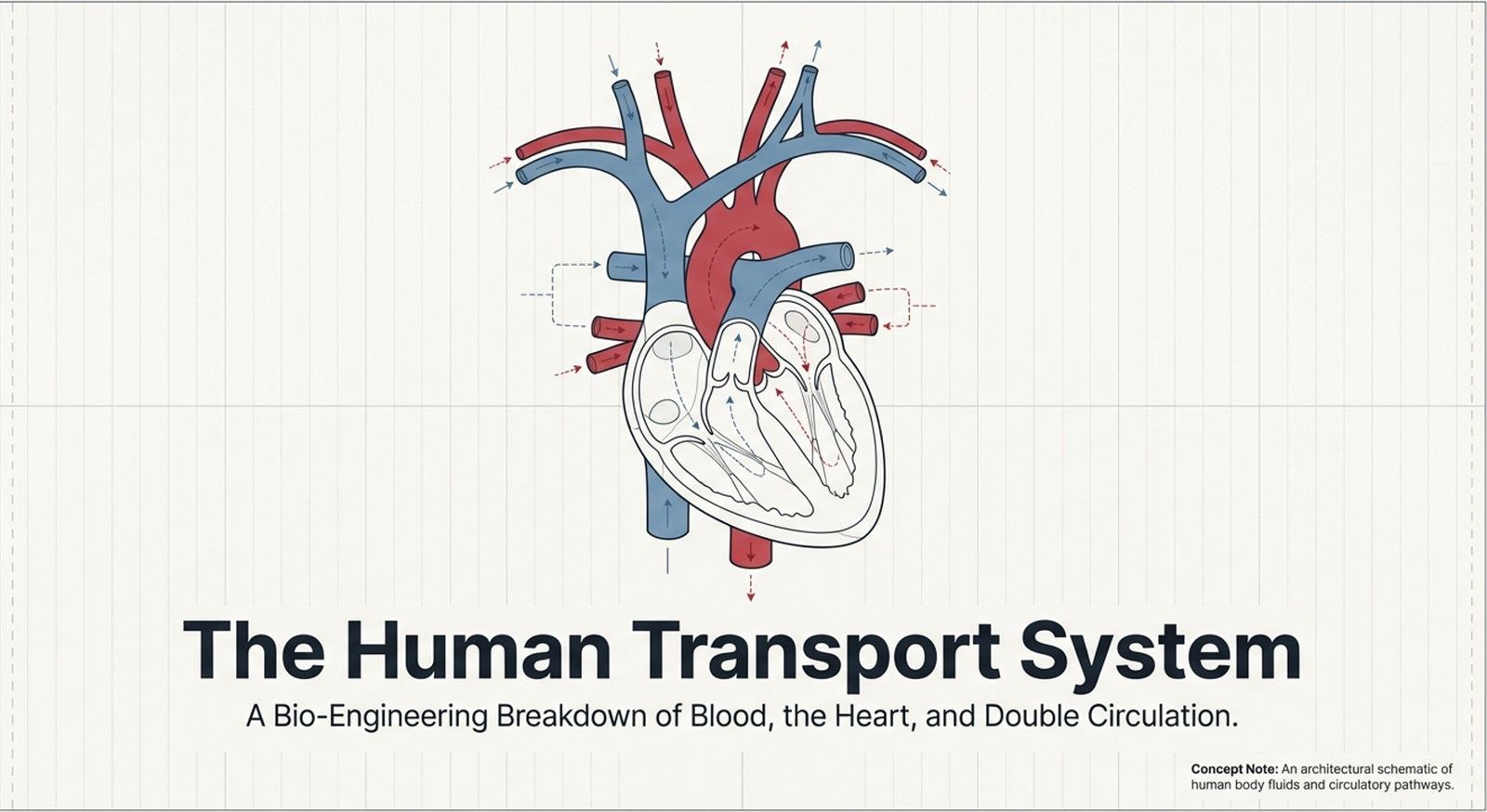
1. Introduction to Internal Transport Mechanisms
In the realm of physiology, the strategic necessity for a circulatory system arises from the limitations of simple diffusion. In lower organisms such as sponges and coelenterates, the exchange of nutrients and the removal of metabolic waste are facilitated by the circulation of water from their surroundings through body cavities. However, as multi-cellular organisms transitioned toward greater complexity and size, the distance between the external environment and internal cells rendered simple diffusion inadequate. Consequently, complex organisms evolved specialized fluids to serve as internal transport media. In humans, blood functions as the primary vehicle for systemic transport, while lymph (tissue fluid) acts as a secondary medium for specific substances. This transition to dedicated fluid systems ensures that the homeostatic requirements of every tissue are met with precision.
2. Blood Composition: Plasma and Formed Elements
Blood is defined as a special connective tissue comprising a fluid matrix, plasma, and various cellular constituents known as formed elements. It is the fundamental medium through which the body maintains homeostasis, providing a dynamic link between all organ systems.
Plasma (55% of Blood Volume)
Plasma is a viscous, straw-colored fluid that serves as the solvent for the body’s transit substances. Its composition is tightly regulated:
- Water (90-92%): The primary medium for transport.
- Major Proteins (6-8%):
- Fibrinogen: Essential for blood coagulation.
- Globulins: Primarily involved in immunological defense mechanisms.
- Albumins: Crucial for maintaining osmotic balance.
- Transit Substances: Plasma serves as a conduit for minerals (Na^+, Ca^{2+}, Mg^{2+}, HCO_3^-, Cl^-), glucose, amino acids, and lipids.
- Note on Serum: It is important to distinguish plasma from serum, which is plasma devoid of its inactive clotting factors.
Formed Elements (45% of Blood Volume)
The cellular portion of blood consists of three specialized categories:
- Erythrocytes (Red Blood Cells – RBCs):
- Count and Production: The most abundant cells, averaging 5.0 to 5.5 million mm^{-3}. They are produced in the red bone marrow of adults.
- Structure: They are biconcave and enucleated in most mammals, a morphology that optimizes surface area for gas exchange.
- Hemoglobin: Each 100ml of blood contains 12-16g of this iron-containing complex protein.
- Life Cycle: RBCs have a lifespan of 120 days. They are eventually sequestered and destroyed in the spleen, the recognized “graveyard of RBCs.”
- Leucocytes (White Blood Cells – WBCs): These nucleated cells are colorless due to the lack of hemoglobin and are generally short-lived. Their concentration ranges from 6,000 to 8,000 mm^{-3}.
| Leucocyte Type | Category | Percentage | Physiological Impact |
| Neutrophils | Granulocyte | 60–65% | Highly phagocytic; first responders to foreign organisms. |
| Monocytes | Agranulocyte | 6–8% | Phagocytic cells that, like neutrophils, destroy invaders. |
| Lymphocytes | Agranulocyte | 20–25% | ‘B’ and ‘T’ forms; responsible for specific immune responses. |
| Eosinophils | Granulocyte | 2–3% | Resist infections and are associated with allergic reactions. |
| Basophils | Granulocyte | 0.5–1% | Secrete histamine, serotonin, and heparin; mediate inflammation. |
- Thrombocytes (Platelets):
- Origin: Cell fragments produced from bone marrow megakaryocytes.
- Count: 1,50,000 to 3,50,000 mm^{-3}.
- Function: They release various factors involved in coagulation. A clinical reduction in platelet count leads to clotting disorders and potentially fatal hemorrhage.
The presence of these diverse cellular elements and surface proteins necessitates precise biochemical matching, leading us to the vital clinical protocols of blood grouping.
3. Human Blood Grouping and Coagulation Dynamics
Blood is not universally interchangeable. Matching donor and recipient biochemistry is a clinical mandate to prevent “clumping” (agglutination) and the subsequent destruction of RBCs, which can lead to systemic failure.
ABO Grouping
The ABO system is based on the presence or absence of two surface antigens (A and B) on RBCs and natural antibodies in the plasma.
| Blood Group | Antigens on RBCs | Antibodies in Plasma | Donor Compatibility |
| A | A | anti-B | A, O |
| B | B | anti-A | B, O |
| AB | A, B | nil (none) | AB, A, B, O (Universal Recipient) |
| O | nil (none) | anti-A, B | O (Universal Donor) |
Rh Grouping and Clinical Significance
Approximately 80% of humans possess the Rh antigen. Erythroblastosis Foetalis represents a critical clinical complication of Rh incompatibility. If an Rh-ve mother carries an Rh+ve fetus, her immune system may be sensitized to Rh antigens during the first delivery. In subsequent pregnancies, maternal Rh antibodies can leak across the placenta, destroying fetal RBCs and causing severe anemia or jaundice. This is prevented by administering anti-Rh antibodies to the mother immediately post-delivery.
The Coagulation Cascade
Coagulation is a protective “cascade” involving plasma factors present in an inactive form.
- Injury stimulates platelets and tissues to release factors that form thrombokinase (an enzyme complex).
- Thrombokinase converts inactive prothrombin into the active enzyme thrombin.
- Thrombin converts soluble fibrinogen into insoluble fibrin threads.
- These threads form a coagulum (a dark reddish-brown scum), trapping dead and damaged formed elements.
- Calcium ions (Ca2+) are essential for these enzymatic reactions.
While blood remains the primary transport fluid, its filtration at the capillary level creates an alternative medium: Lymph.
4. Lymphatic System: The Interstitial Bridge
As blood circulates through the capillaries, high pressure forces water and small solutes into the spaces between cells, leaving behind larger proteins and formed elements. This is the interstitial fluid or tissue fluid.
Physiological Roles of Lymph
- Exchange Medium: Lymph has the same mineral distribution as plasma and facilitates the exchange of nutrients and gases between blood and cells.
- Immune Defense: It contains specialized lymphocytes for immune responses.
- Nutrient Transport: It acts as a carrier for hormones and nutrients.
- Fat Absorption: Fats are absorbed through the lymphatic system in specialized vessels called lacteals within the intestinal villi.
This fluid is eventually returned to the major veins by the lymphatic network, a process that ensures tissue fluid balance is maintained before we consider the broader circulatory pathways that evolved to move these fluids.
5. Comparative Anatomy of Circulatory Pathways
The evolution of the vertebrate heart reflects an increasing requirement for metabolic efficiency and the separation of oxygenated and deoxygenated blood.
- Open vs. Closed Systems: Arthropods and molluscs utilize an open system where blood flows through sinuses. Annelids and chordates utilize a closed system, which is more advantageous as it allows for precisely regulated, high-pressure flow to specific tissues.
- Evolution of Heart Chambers:
- 2-Chambered (Fishes): One atrium and one ventricle; utilizes single circulation.
- 3-Chambered (Amphibians/Reptiles): Two atria and one ventricle; results in incomplete double circulation due to mixing in the ventricle.
- 4-Chambered (Crocodiles, Birds, Mammals): Two atria and two ventricles, allowing for complete separation of blood.
The development of the four-chambered heart provided the necessary anatomical foundation for the specialized human model, which maximizes oxygenation efficiency.
6. Structure and Myogenic Regulation of the Human Heart
The human heart is a mesodermally derived organ protected by the pericardium, a double-walled membrane containing pericardial fluid.
Valvular Apparatus and Unidirectional Flow
- Tricuspid Valve: Three muscular flaps between the right atrium and ventricle.
- Bicuspid (Mitral) Valve: Between the left atrium and ventricle.
- Semilunar Valves: Located at the exits of the ventricles into the pulmonary artery and aorta. These valves are essential for preventing the backflow of blood, ensuring strictly unidirectional movement.
Nodal Tissue and Autoexcitability
The heart is myogenic, meaning it generates its own rhythmic impulses via nodal tissue:
- Sino-atrial Node (SAN): The Pacemaker, located in the right upper corner of the right atrium, generates 70-75 action potentials per minute.
- Atrio-ventricular Node (AVN): Located in the lower left corner of the right atrium.
- Conduction Pathway: SAN \rightarrow AVN \rightarrow AV Bundle \rightarrow Bundle of His \rightarrow Purkinje fibres.
The generation and conduction of these action potentials are the mandatory precursors to the mechanical events of the cardiac cycle.
7. The Cardiac Cycle and Clinical Diagnostics
The cardiac cycle is the sequential repetition of systole (contraction) and diastole (relaxation). In a healthy individual, the cycle duration is 0.8 seconds.
Phases of the Cycle
- Joint Diastole: All chambers are relaxed; tricuspid and bicuspid valves are open.
- Atrial Systole: SAN triggers atrial contraction, increasing ventricular filling by 30%.
- Ventricular Systole: Ventricles contract, pressure rises, closing the AV valves (first sound) and opening the semilunar valves.
Cardiac Output
Each ventricle pumps approximately 70 mL of blood per beat, a volume known as the Stroke Volume or Beat Volume.
- Cardiac Output = Stroke Volume (70 mL) \times Heart Rate (72 bpm) \approx 5 Liters/min.
Clinical Significance: Sounds and ECG
- Heart Sounds: The “Lub” (closure of AV valves) and “Dub” (closure of semilunar valves) are primary diagnostic indicators.
- Electrocardiogram (ECG): A graphical trace of electrical activity.
- P-wave: Atrial depolarization (contraction).
- QRS complex: Ventricular depolarization (beginning of systole).
- T-wave: Ventricular repolarization. The end of the T-wave marks the end of systole. Any deviation from the standard ECG shape is a diagnostic marker for cardiac abnormality.
The rhythmic coordination of the cardiac cycle ensures that blood is effectively partitioned into the two separate circuits of double circulation.
8. Double Circulation and Specialized Vascular Connections
The human system utilizes two distinct circuits that ensure the separation of oxygenated and deoxygenated blood.
Vascular Anatomy
Every artery and vein consists of three distinct layers:
- Tunica intima: Inner lining of squamous endothelium.
- Tunica media: Middle layer of smooth muscle and elastic fibres. It is comparatively thinner in the veins.
- Tunica externa: External layer of fibrous connective tissue.
Circulatory Circuits and Specialized Systems
- Pulmonary Circulation: Right ventricle \rightarrow Pulmonary artery \rightarrow Lungs \rightarrow Pulmonary veins \rightarrow Left atrium.
- Systemic Circulation: Left ventricle \rightarrow Aorta \rightarrow Tissues \rightarrow Vena cava \rightarrow Right atrium.
- Hepatic Portal System: A unique connection where the hepatic portal vein carries blood from the intestine to the liver before it reaches the systemic circulation.
- Coronary System: A dedicated network of vessels supplying the cardiac musculature itself.
Maintaining the integrity of these pathways requires sophisticated neural and hormonal regulation.
9. Regulation of Cardiac Activity and Clinical Disorders
While the heart is myogenic, its activity is moderated by the Medulla Oblongata through the Autonomic Nervous System (ANS).
- Sympathetic Signals: Increase heart rate and ventricular contraction strength, thereby increasing cardiac output.
- Parasympathetic Signals: Decrease heart rate and conduction speed, lowering cardiac output.
- Hormonal Regulation: Adrenal medullary hormones also increase cardiac output.
Circulatory Disorders
- Hypertension (High Blood Pressure): Sustained readings of 140/90 mmHg or higher (Normal: 120/80). It leads to heart disease and organ damage (brain/kidneys).
- Coronary Artery Disease (CAD/Atherosclerosis): Narrowing of the arterial lumen due to deposits of fat, calcium, and cholesterol.
- Angina Pectoris: Acute chest pain resulting from inadequate oxygen supply to the heart muscle.
- Heart Failure: The heart fails to pump effectively; often results in lung congestion. It is distinct from cardiac arrest (heart stops) and heart attack (sudden muscle damage).
The seamless integration of these fluid dynamics and mechanical regulations is the foundation of human survival, providing the necessary infrastructure for cellular life.