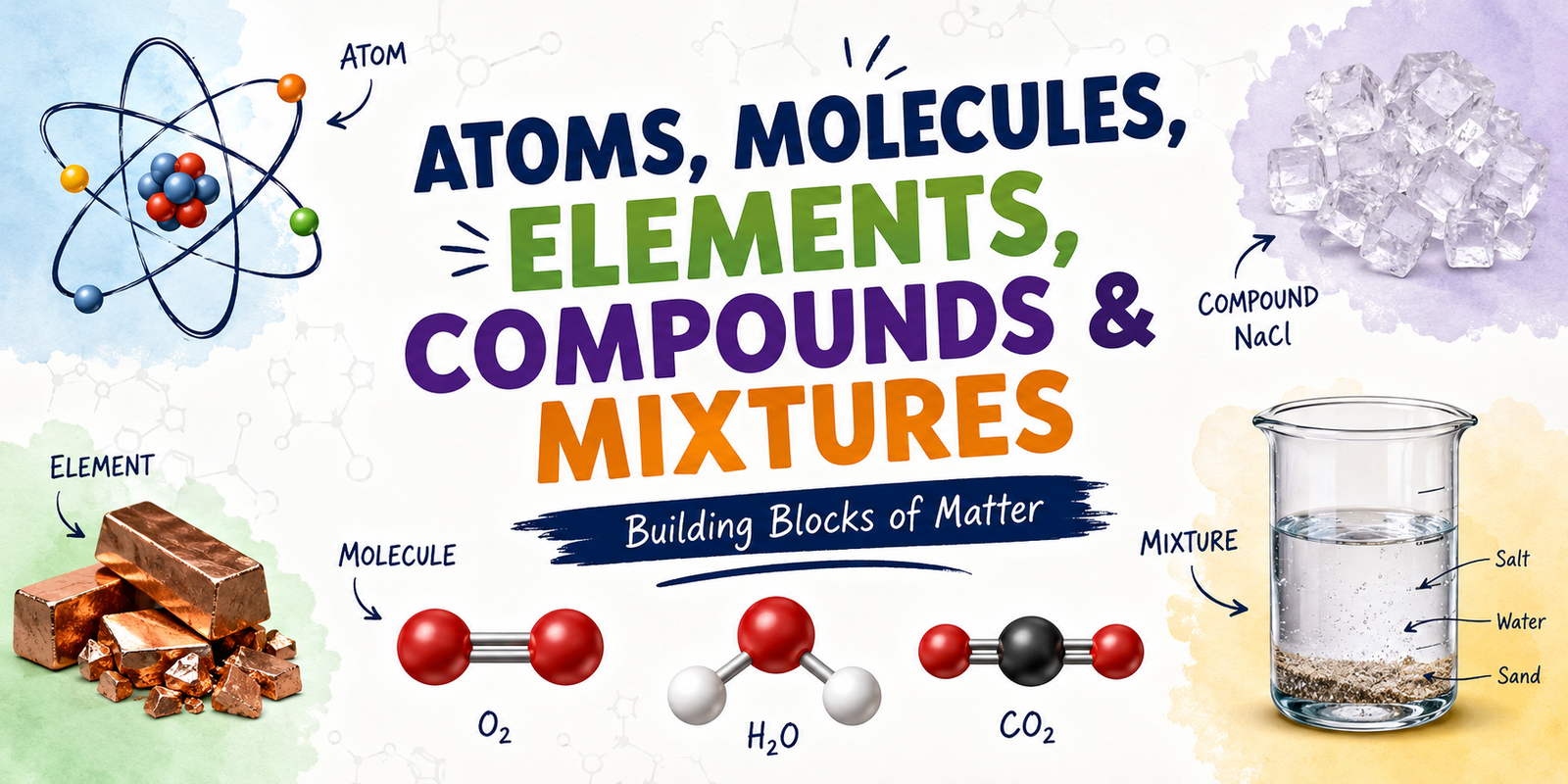
The Building Blocks of Matter
Have you ever wondered what everything around you is made of?
From the water you drink to the air you breathe, everything is made of tiny particles called atoms.
In this blog post, we will explore:
- Atoms
- Molecules
- Elements
- Compounds
- Mixtures
Let’s dive into the fascinating world of chemistry!
What Is an Atom?
An atom is the smallest particle of an element that still keeps the properties of that element.
Think of atoms as the “LEGO blocks” of matter.
Examples:
- One oxygen atom (O)
- One hydrogen atom (H)
- One carbon atom (C)
Atoms are extremely tiny — millions of them can fit on the tip of a pencil!
What Is an Element?
An element is a pure substance made of only one type of atom.
Examples of elements:
- Gold (Au)
- Iron (Fe)
- Oxygen (O₂)
- Copper (Cu)
Each element has:
- its own symbol
- unique properties
- only one kind of atom
Fun Fact
There are more than 100 known elements in the periodic table!
What Is a Molecule?
A molecule forms when two or more atoms join together chemically.
Examples:
- O₂ → oxygen molecule
- H₂O → water molecule
- CO₂ → carbon dioxide molecule
Molecules can contain:
- the same type of atoms
- different types of atoms
Molecules of Elements vs Molecules of Compounds
Molecules of Elements
Made of the same type of atom.
Examples:
- O₂
- N₂
- H₂
These are still elements because only one type of atom is present.
Molecules of Compounds
Made of different kinds of atoms bonded together.
Examples:
- H₂O
- CO₂
- CH₄
These are compounds.
What Is a Compound?
A compound is a pure substance formed when different elements chemically combine in a fixed ratio.
Examples:
| Compound | Elements Present |
|---|---|
| Water (H₂O) | Hydrogen + Oxygen |
| Carbon dioxide (CO₂) | Carbon + Oxygen |
| Sodium chloride (NaCl) | Sodium + Chlorine |
Important Features of Compounds
- Different atoms are chemically bonded.
- They have fixed compositions.
- They form completely new substances.
Example
Hydrogen is flammable.
Oxygen helps burning.
But water can extinguish fire!
Amazing, right?
What Is a Mixture?
A mixture contains two or more substances physically mixed together.
Examples:
- Air
- Salt water
- Soil
- Milk
In mixtures:
- substances are NOT chemically bonded
- composition can vary
- substances keep their original properties
Types of Mixtures
1. Homogeneous Mixture
Uniform throughout.
Examples:
- Salt water
- Air
- Brass
You cannot easily see the different components.
2. Heterogeneous Mixture
Not uniform throughout.
Examples:
- Salad
- Soil
- Sand and water
Different parts can be seen clearly.
Difference Between Compounds and Mixtures
| Compound | Mixture |
|---|---|
| Chemically bonded | Physically mixed |
| Fixed composition | Variable composition |
| New properties formed | Original properties remain |
| Difficult to separate | Easy to separate physically |
Understanding Chemical Formulae
Water → H₂O
This means:
- 2 hydrogen atoms
- 1 oxygen atom
Carbon Dioxide → CO₂
This means:
- 1 carbon atom
- 2 oxygen atoms
Ammonia → NH₃
This means:
- 1 nitrogen atom
- 3 hydrogen atoms
Real-Life Examples Around You
| Substance | Type |
|---|---|
| Air | Mixture |
| Gold | Element |
| Water | Compound |
| Oxygen gas | Element |
| Milk | Mixture |
| Carbon dioxide | Compound |
Why Are These Concepts Important?
Understanding atoms and molecules helps scientists:
- make medicines
- develop new materials
- understand pollution
- study life processes
- explore space
Chemistry is everywhere!
Quick Revision
Atom
Smallest particle of an element.
Element
Pure substance with one type of atom.
Molecule
Two or more atoms joined together.
Compound
Different atoms chemically bonded.
Mixture
Substances physically mixed.
Mini Quiz Time!
- Is air a compound or mixture?
- Is O₂ an element or compound?
- Why can mixtures be separated physically?
- How many atoms are present in H₂O?
Try answering these yourself!
Final Thoughts
Atoms, molecules, elements, compounds, and mixtures are the foundation of chemistry. Once you understand these concepts, many scientific ideas become much easier to learn.
The next time you drink water, breathe air, or see rust on iron, remember — chemistry is happening all around you!
Happy Learning!