Introduction: The Mystery of the Deflecting Needle
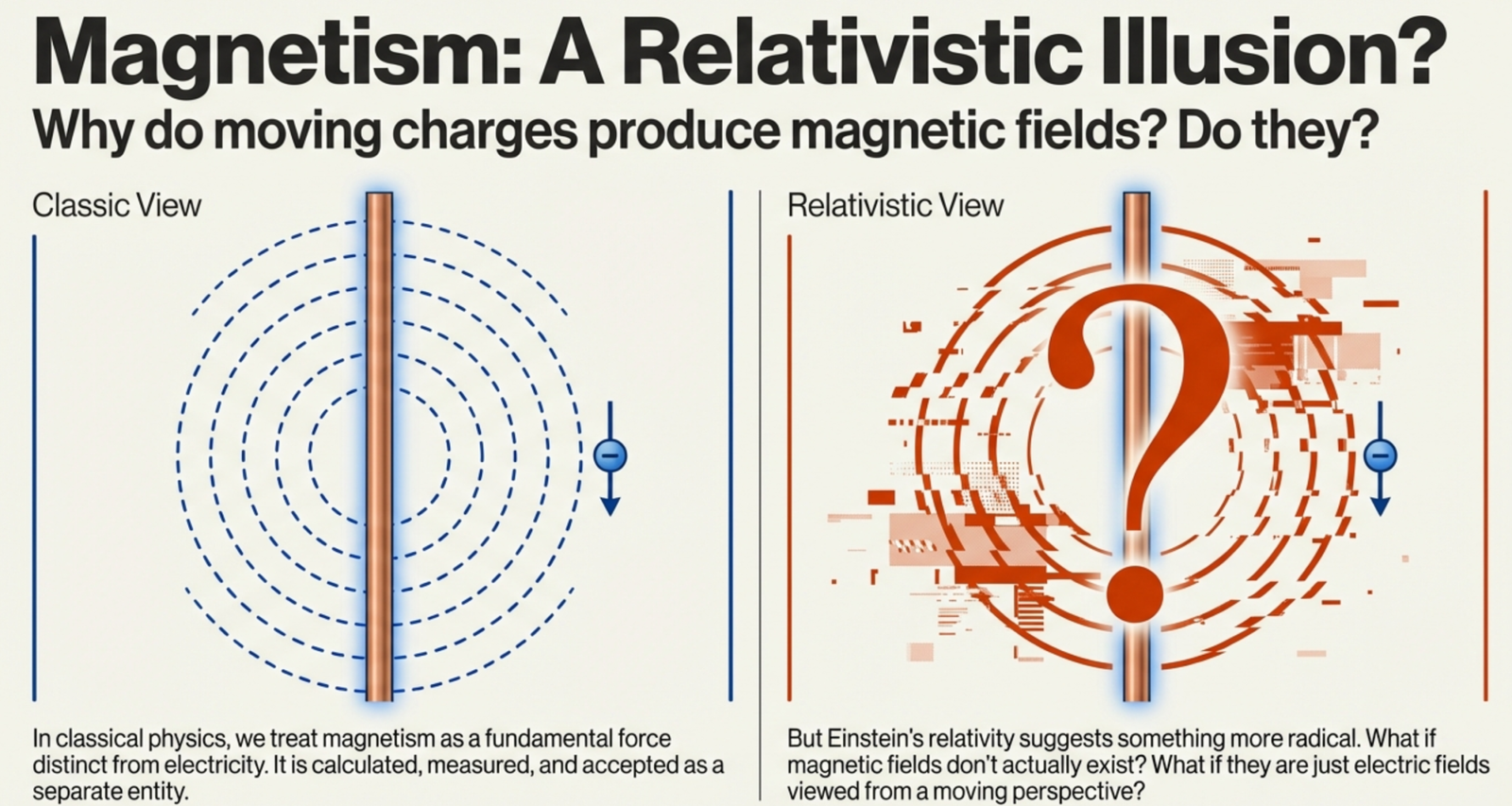
If you place a magnetic needle next to a wire carrying an electric current, the needle deflects. For over a century, the standard classroom explanation has been straightforward: moving charges produce magnetic fields. But this raises a fundamental, almost haunting question: why? Why should the mere act of motion conjure a secondary force that simply does not exist when the charges are at rest?
Albert Einstein offered a perspective that remains one of the most elegant “detective moves” in the history of physics. He proposed that the “magnetic” force isn’t a separate entity at all. Instead, what we perceive as magnetism can be explained entirely through Coulomb’s law—the basic rule of electric attraction and repulsion—once you factor in the weird, reality-warping effects of special relativity. To Einstein, magnetism is essentially electricity in disguise, a phantom force born from our perspective in space and time.
Takeaway 1: Your “Neutral” Wire Is Actually Charged (In the Right Frame)
Length Contraction and the Secret Charge of Wires
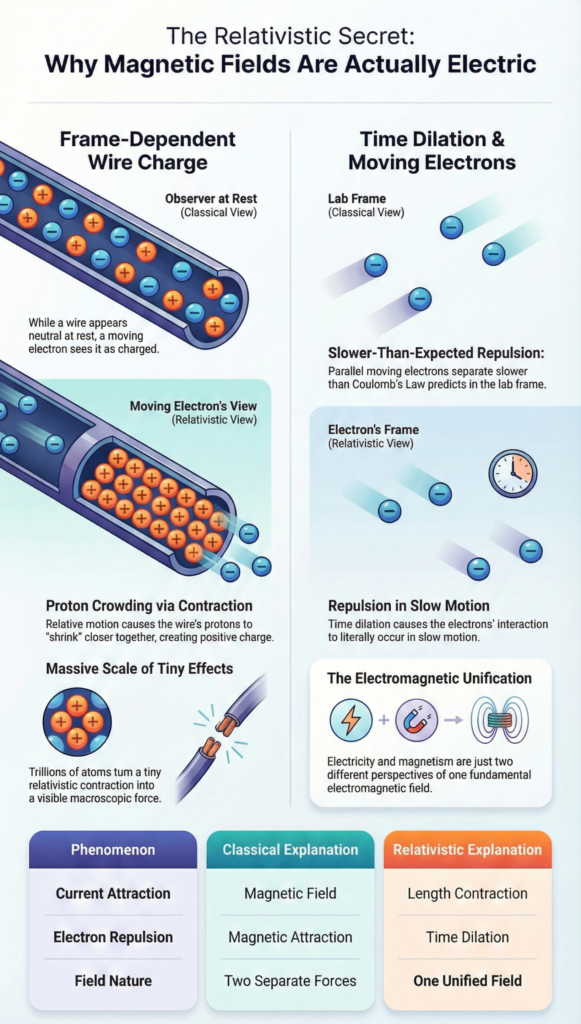
In our laboratory reference frame, a current-carrying wire is electrically neutral. For every positive proton, there is a negative electron; the net charge is zero, and the wire shouldn’t exert an electric force on an external charge. Yet, if we place a moving electron next to that wire, it is undeniably attracted.
To solve this, we must jump into the reference frame of the moving electron. From this perspective, the electron is at rest, while the protons in the wire are suddenly rushing in the opposite direction. This shift triggers a phenomenon called length contraction.
“When things are moving… its length in the direction of motion shrinks. This is called length contraction.” — The perspective of Einstein’s theory
In the electron’s frame, the moving protons contract, crowding closer together and increasing their positive charge density. Simultaneously, the electrons within the wire—which were moving in the lab frame but are now stationary relative to our test electron—undergo a “reverse contraction.” Because they have stopped moving, they expand and move further apart.
This dual effect is “insane and crazy,” yet mathematically inevitable. From the electron’s perspective, the wire is no longer neutral; it has gained a net positive charge. Coulomb’s law then takes over: the negative electron is simply attracted to the now-positively charged wire. No “magnetism” is required to explain the movement; it is pure electrostatics viewed from a different frame of reference.
Takeaway 2: Why Parallel Moving Electrons Move in “Slow Motion”
Time Dilation: The Reason Magnetism Feels “Weaker” Than Electricity
Relativity also resolves a second puzzle: why two parallel moving electrons separate more slowly than Coulomb’s law predicts. Traditionally, we claim their motion creates magnetic fields that partially cancel out their electric repulsion. Einstein, however, points to time dilation.
According to relativity, “clocks” on moving objects tick slower relative to a stationary observer. Think of a friend waving goodbye from a speeding train; to you on the platform, they appear to be waving in slow motion. This same logic applies to subatomic particles.
If we jump into the frame of the moving electrons, they are at rest relative to each other and repel at a normal rate. But when we observe them from the lab frame, they are in motion. Because of time dilation, we see the rate of separation happening in slow motion. The electrons appear to separate more slowly not because of a “mysterious magnetic force,” but because the relativistic warping of time has slowed the physical interaction itself. This insight simplifies our universe, removing the need for “hidden” forces by showing that time itself is the variable.
Takeaway 3: Relativity Isn’t Just for Spaceships—It’s in Your Walls
The Macroscopic Power of “Negligible” Effects
A common skepticism arises here: relativity is usually reserved for objects screaming through the vacuum of space at near-light speeds. In a household wire, electrons aren’t racing; they are “crawling.” Their drift speed is incredibly slow. How can such a “crawling” pace trigger a relativistic effect strong enough to move a physical needle?
The answer is a matter of sheer, astronomical scale. While the length contraction at these speeds is “insanely negligible” for a single particle, a wire contains trillions upon trillions of protons and electrons. When you sum up this microscopic relativistic shift across that massive volume of particles, the effect scales into a macroscopic force. It is a profound realization: the very fact that your electronics function is an everyday example of Einstein’s relativity in action right inside your walls.
Takeaway 4: The End of the “Electric vs. Magnetic” Debate
The Unified Electromagnetic Field
The ultimate takeaway is that electric and magnetic fields are not two different forces of nature. They are a single entity. Whether a field appears “electric” or “magnetic” is not an absolute property of the field itself, but a consequence of your choice of reference frame.
A field that looks purely magnetic to one observer can transform and appear as an electric field to another. This realization unifies these observations into a single, underlying phenomenon.
“Electric and magnetic fields might be the same manifestation of something more fundamental… which we called electromagnetic fields.” — From the source material
By applying relativity, physics stops treating electricity and magnetism as separate chapters and begins treating them as one unified force: the electromagnetic force.
Conclusion: A Paradox to Ponder
Einstein unified the forces of nature by demonstrating that they are products of the geometry of space and time. However, this leaves us with a fascinating puzzle: the Charge Conservation Paradox.
If a wire appears neutral in the lab but develops a net charge in the electron’s frame due to length contraction, where does that “extra” charge come from? Charge is supposed to be absolute and conserved—it cannot simply be created by changing your perspective.
To see the depth of this mystery, imagine a complete circuit powered by a battery. If one section of the wire becomes charged from a certain perspective, how does the rest of the loop compensate to keep the total charge balanced? It is a question that forces us to reconsider how our perspective defines the very reality of the forces we measure.
Infographics